Gravity Break Launch

Chandan Singh
| 23-04-2026
 · Science Team
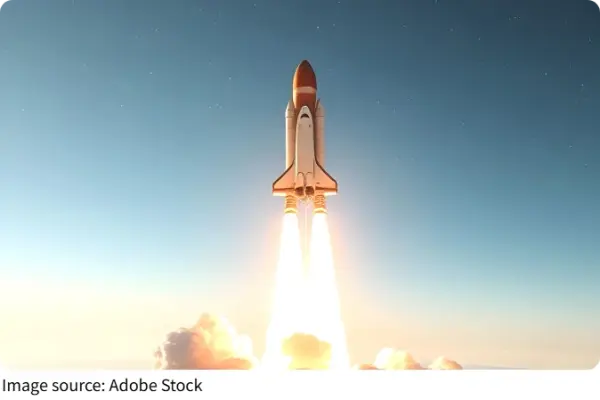
When we watch a rocket launch, it almost feels unreal. A massive machine slowly rises, then suddenly speeds upward and disappears into space.
How can something so heavy fight against Earth’s strong pull? The answer is not magic, but a clever mix of physics, energy, and smart engineering. Let’s break it down step by step in a simple way we can all understand.
The basic idea: push and response
At the heart of rocket flight is a simple rule from physics: when something pushes in one direction, it gets pushed back in the opposite direction with equal strength. A rocket burns fuel and shoots out hot gas at very high speed backward. In response, the rocket itself moves forward.
We can imagine it like blowing up a balloon and letting it go. The air rushes out, and the balloon flies in the opposite direction. Rockets use the same idea, but in a much more powerful and controlled way. This continuous push is what starts the journey upward.
Overcoming Earth’s pull
Earth is constantly pulling everything toward its center. This pull is called gravity. For a rocket to rise, its upward force must be stronger than gravity’s downward pull.
That is why rockets need extremely strong engines. They burn special fuel that releases a huge amount of energy in a short time. This energy becomes a powerful upward push. When this push is stronger than gravity, the rocket begins to rise. If it becomes even stronger, the rocket can continue speeding up instead of slowing down.

The importance of reaching the right speed
Escaping Earth is not just about going up. It is also about going fast. There is a special speed needed to stay in space without falling back. This is about 7.9 kilometers per second, which is extremely fast in everyday terms.
Once a rocket reaches this speed, it can stay in orbit around Earth. If it goes even faster, it may travel farther into space. Reaching this speed requires careful planning and powerful engines working together for several minutes during launch.
Why rockets are built in stages
Rockets are not built as one solid piece all the way to space. Instead, they are made of multiple sections. These sections are called stages.
Each stage carries fuel and engines. When one stage finishes its job, it is no longer needed and is dropped away. This makes the rocket lighter. A lighter rocket is easier to speed up. With each stage removed, the remaining rocket becomes more efficient and can reach higher speeds.
This step-by-step design is one of the smartest parts of rocket engineering.
Fuel as the energy source
Rockets need a huge amount of energy to launch. This energy comes from fuel stored inside the rocket. When the fuel burns, it creates hot gas that shoots out at high speed.
This process transforms chemical energy into motion. The stronger and more efficient the fuel, the more powerful the push. Without this energy release, the rocket would not be able to lift off the ground.
Careful path planning during launch
A rocket does not fly straight up forever. Its path is carefully designed. At first, it moves upward to leave the dense part of the atmosphere. Then it gradually curves into a horizontal direction.
This controlled path helps the rocket build speed efficiently. It also reduces unnecessary energy loss. Engineers plan every second of the flight to make sure the rocket reaches space safely and smoothly.
Putting it all together
When we combine all these ideas, the process becomes clear. A rocket lifts off because its engines produce a force stronger than gravity. It gains speed step by step. It becomes lighter as stages drop away. It follows a carefully designed path while using powerful fuel energy.
Eventually, it reaches the required speed to enter space and continue its journey beyond Earth’s pull.
Final thoughts for us
Rockets may look complex, but the idea behind them is surprisingly logical. With the right force, the right speed, and smart design, humans have found a way to travel beyond Earth.
So next time we see a rocket launch, we can understand that it is not just fire and motion, but a carefully balanced system of physics and engineering working together to open the door to space.
How Do Rockets Overcome The Earth's Gravity?
Video by Explified Labs