Cheetah Stops Short
Ravish Kumar
| 19-03-2026
 · Animal Team
A Sudden Encounter That Stops Your Heart
Imagine stepping out of your car and walking toward your front door when you suddenly notice an animal moving quickly in your direction.
It might be something small, like a squirrel racing across the yard or a raccoon wandering nearby. Even when the animal means no harm, the feeling of something running straight toward you can instantly make your heart race.
Now imagine that moment again—but instead of a small animal, it's a cheetah charging directly toward you.
Footage circulating online captures exactly this kind of intense encounter. In the clip, a person stands in an open landscape while two cheetahs begin running straight toward the camera. Within seconds, the distance closes rapidly, creating a dramatic moment that feels far more dangerous than it actually is.
The scene looks frightening at first, but the science behind cheetah behavior helps explain why the outcome is far calmer than viewers might expect.
A Key Stronghold for Cheetahs
The video was filmed in Namibia, a country in southwestern Africa known for its wide open landscapes and wildlife conservation efforts. Namibia is widely recognized as one of the most important regions for cheetah survival.
Although exact numbers can vary depending on the source, conservation organizations generally estimate that the global wild cheetah population is relatively small compared to many other large animals. A significant portion of these animals live within Namibia's borders, making the country a critical stronghold for the species.
Population estimates often depend on several factors, including
Survey methods / Whether cubs are counted / How recent the data is
Because cheetahs roam large territories and can be difficult to track, researchers rely on different monitoring techniques. These variations can lead to slightly different population estimates, but the overall conclusion remains the same: Namibia plays a vital role in protecting the species.
A Sprint That Looks Like an Attack
In the footage, a cheetah named Quasa appears in the distance alongside another cheetah. At first, both animals stand calmly on the landscape. Then suddenly, they break into a run.
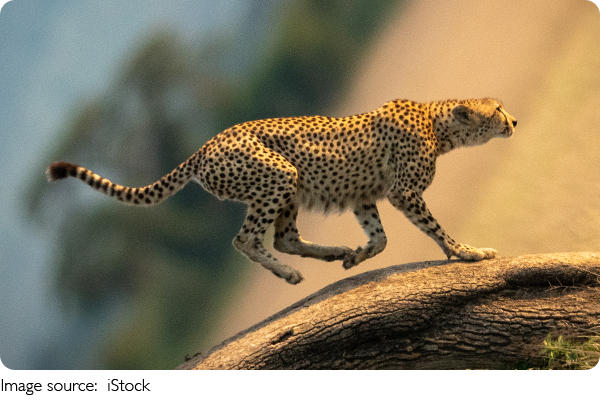
Cheetahs are the fastest land mammals on Earth. Their bodies are built for explosive bursts of speed, allowing them to accelerate rapidly when chasing prey. When they begin sprinting, the change in motion is dramatic and immediate.
During a chase, cheetahs can reach speeds approaching seventy miles per hour in short bursts. As they run, dust rises behind them and their strides stretch far across the ground.
When an animal capable of that speed runs directly toward a person, the moment can feel extremely intense—even when the animal has no intention of attacking. In the video, the cheetahs close the distance quickly, creating the impression of a dangerous encounter.
Then, just as suddenly as the sprint begins, Quasa stops.
The cheetah slows abruptly, kicking up dirt as it halts only a short distance from the person filming. The dramatic stop shows both the animal's incredible control and the importance of context in wildlife encounters.
Understanding Cheetah Behavior
Cheetahs are unique among large predators. Unlike many powerful big cats that rely on strength and endurance, cheetahs are built primarily for speed.
Their bodies are relatively lightweight and streamlined, allowing them to run faster than any other land animal. A fully grown cheetah typically weighs between seventy-five and one hundred forty pounds and has long legs, flexible spines, and large nasal passages that support rapid bursts of running.
Several biological features make this speed possible, including
Flexible spine / Long stride length / Large lung capacity
These adaptations allow cheetahs to accelerate quickly and maneuver during high-speed chases. However, their lighter build also means they rely more on agility than raw strength.
Because of this, cheetahs often avoid unnecessary confrontations whenever possible.
Do Cheetahs See Humans as Prey?
In many areas where cheetahs live, the animals frequently encounter humans through tourism, conservation work, and nearby communities. Over time, this exposure means cheetahs sometimes become familiar with the presence of people in their environment.
Wildlife experts note that cheetahs generally show cautious behavior around humans. Instead of seeking conflict, they often prefer to observe from a distance or move away from unfamiliar activity.
The key factor in the video is that the cheetah likely recognizes the person filming. When animals are raised or monitored within conservation settings, they may become accustomed to specific caretakers or researchers.
This familiarity changes the meaning of the sprint. Rather than an aggressive charge, the run may simply be playful excitement or curiosity toward someone the animal already knows.
Even so, experts always stress the importance of maintaining respectful distance from wildlife.
Respecting the Power of Wild Animals
Moments like this can easily be misunderstood when viewed without context. A cheetah sprinting toward a person can appear extremely dangerous, but the reality is often more nuanced.
Wild animals behave according to instinct, environment, and experience. While cheetahs are not typically associated with attacks on humans, they remain powerful predators with sharp claws and strong jaws.
Anyone encountering wildlife should remember several key principles
Maintain distance / Avoid sudden movement / Respect natural space
These guidelines help reduce stress for animals and improve safety for people.
A Dramatic Moment With a Scientific Explanation
The viral footage of Quasa sprinting toward a human captures the incredible speed and athletic ability that make cheetahs such remarkable animals. What looks like a frightening encounter is actually a powerful demonstration of their agility and behavior.
Science helps explain the moment: a fast predator built for explosive speed, a familiar human presence, and the animal's ability to stop with precise control.
Encounters like this remind us how extraordinary wildlife can be—and why understanding animal behavior is essential for appreciating these animals safely from a respectful distance.