Joyful Risk in Puddles

Arvind Singh
| 19-03-2026
 · Lifestyle Team
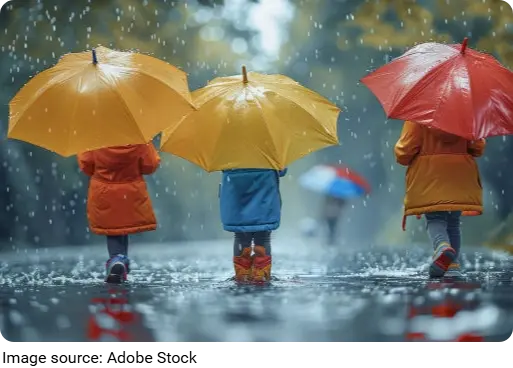
A shallow puddle after the rain may seem ordinary, but to a child, it is an open invitation.
The surface reflects the sky, the edges shift with each step, and every splash creates a new discovery. What appears messy or uncertain to adults becomes a rich learning space for children.
Teaching joyful risk through puddle play is not about removing uncertainty—it is about guiding children to explore it safely and confidently.
What Is Joyful Risk?
Joyful risk refers to opportunities where children engage in manageable challenges that involve uncertainty but offer meaningful rewards. For example, a study published in Child Indicators Research found that children who engage in risky play show higher levels of well‑being, involvement, and physical activity, and that such play helps children learn to assess and manage challenges on their own.
Rather than eliminating all risks, educators and caregivers focus on creating environments where children can test limits within safe boundaries. This balance is essential for healthy development.
Why Puddle Play Matters
Puddle play is one of the simplest forms of outdoor exploration, yet it offers multiple developmental benefits:
- Sensory Engagement
Water, mud, and varying textures stimulate touch and perception.
- Physical Development
Jumping, balancing, and stepping through uneven surfaces improve coordination.
- Emotional Growth
Children learn to manage uncertainty and build confidence through small challenges.
- Scientific Curiosity
Observing ripples, reflections, and water movement introduces basic scientific concepts.
According to Ellen Beate Hansen Sandseter, professor of early childhood education at Queen Maud University College in Norway, children benefit greatly from risky and unstructured outdoor play, which includes activities like exploring puddles, uneven ground, and natural environments. Sandseter’s research shows that when children engage in self‑directed, hands‑on outdoor play, they develop physical coordination, emotional resilience, and problem‑solving skills because they are learning to assess and manage small challenges in real time. This kind of play — far from being frivolous — helps children build confidence and independence as they interact with the world around them.
How to Teach Joyful Risk
Guiding children through puddle play requires intention rather than control. The goal is to support exploration while maintaining safety:
- Set Clear Boundaries
Define safe areas and explain simple rules, such as avoiding deep or fast-moving water.
- Encourage Exploration
Allow children to decide how to interact with the puddle—stepping, jumping, or observing.
- Ask Open Questions
Prompt thinking with questions like “What happens when you jump harder?”
- Model Calm Behavior
Demonstrate curiosity rather than concern to build confidence.
Managing Safety Without Limiting Play
Safety remains important, but it should not remove the learning value of risk:
- Check the Environment
Ensure the area is free from sharp objects or unsafe surfaces.
- Dress Appropriately
Waterproof boots and comfortable clothing help children focus on play.
- Supervise Actively
Stay present and attentive without interrupting exploration.
- Teach Awareness
Help children recognize when a situation feels too challenging.
This approach allows children to experience risk in a controlled and supportive way.
Learning Through Experience
Puddle play provides natural opportunities for learning through action:
- Cause and Effect
Jumping creates splashes; stepping lightly creates ripples.
- Problem-Solving
Children figure out how to cross without getting too wet—or choose to get wet on purpose.
- Social Interaction
Shared play encourages cooperation and communication.
These experiences cannot be fully replicated through structured indoor activities.
Common Misconceptions
Some adults hesitate to allow puddle play due to concerns that can be addressed:
- “It's too messy”
Mess is part of sensory learning and can be managed with preparation.
- “It's unsafe”
With proper supervision and environment checks, risks remain manageable.
- “It has little educational value”
Research shows that unstructured outdoor play supports multiple areas of development.
Creating a Supportive Environment
Encouraging joyful risk does not require elaborate setups:
- Choose the Right Location
Flat, shallow puddles are ideal.
- Allow Time
Unhurried play leads to deeper engagement.
- Accept Imperfection
Not every moment needs to be controlled or directed.
A Small Puddle, A Big Lesson
Watching a child step into a puddle for the first time reveals something powerful. There is hesitation, then curiosity, and finally a decision. That moment—when uncertainty turns into action—is where learning happens.
Joyful risk in puddle play is not about the water itself. It is about giving children the space to explore, to question, and to grow through experience. In a world that often prioritizes control and predictability, a simple puddle reminds us that some of the most meaningful lessons begin with a single, uncertain step.